Queen's Verdict
Twelve Angry Cylinders
I took my seven-year-old to see the new Aston Martin Valen. He went quiet, which never happens, and then he asked the one question I wasn't ready for.
Wed 26 August 2026 · Queen of Cars
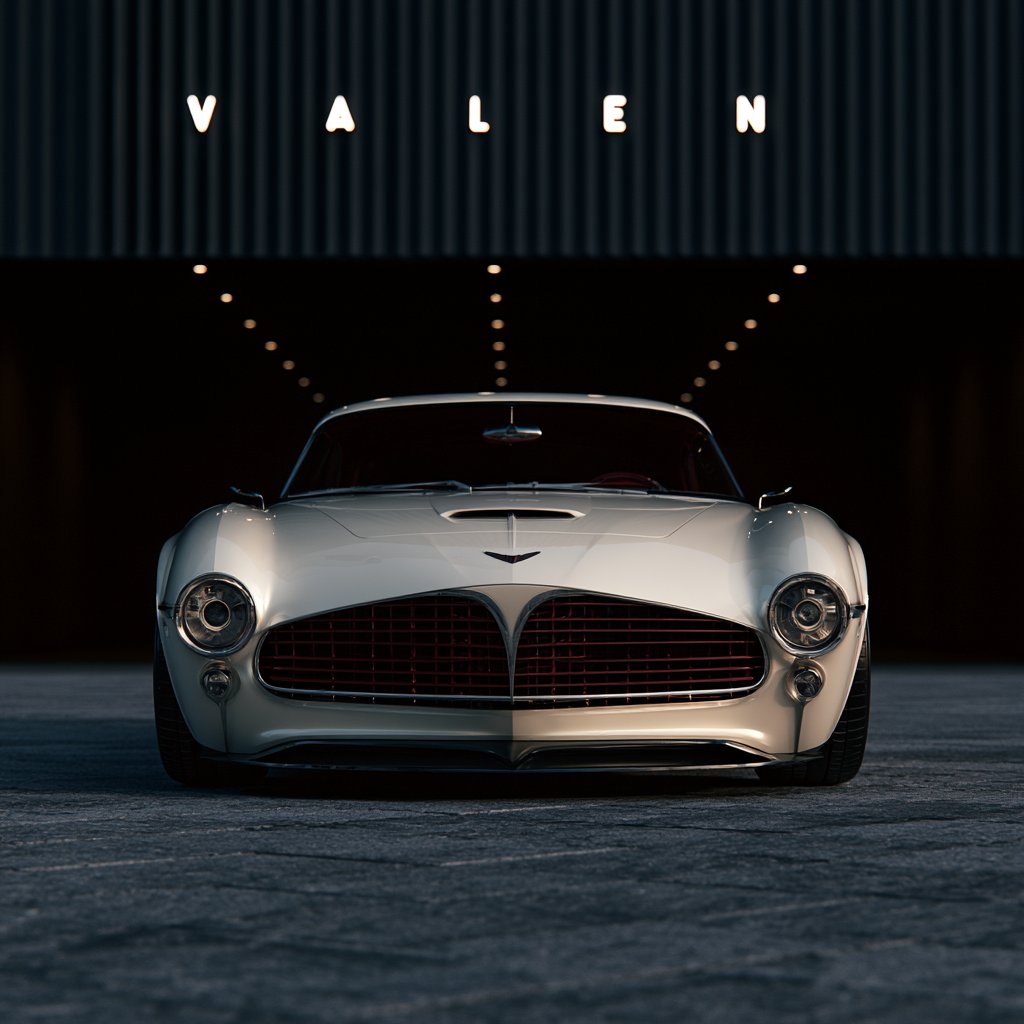
“Five crowns. A hundred and fifty lifeboats with a V12 in each, and the loudest argument that petrol deserves a proper send-off.”
There is a particular silence a seven-year-old makes when something has genuinely got him. It is not the polite silence of being told to behave in a shop. It is a full stop. The talking stops mid-sentence, the hands come up onto the glass or the rope or whatever is keeping him off it, and for about four seconds you get to watch a child's entire operating system reboot.
I got four seconds. Maybe five. Then: "Mum. Mum. Is that real?"
Yes. That's real. That is the Aston Martin Valen, and here is what is inside it.
Five point two litres. Twelve cylinders. Two turbochargers. Eight hundred and thirty-eight brake horsepower, sent with no hybrid assistance and no apology whatsoever to the rear wheels only. A hundred and fifty of them will be built. In the entire world. Ever. One and a half million pounds each, which is somewhere north of three million Australian before this country has even cleared its throat and said the words luxury car tax.
And the bit that made me stop reading and start planning a Saturday morning around it: it is the most powerful front-engined production car the world has ever built.
Not the most powerful Aston. The most powerful front-engined car. Anywhere. By anyone.
The numbers, which are frankly unhinged
The engine is the 5.2 twin-turbo V12, and in 2026 that is an act of open defiance. Everyone else has downsized, hybridised, electrified or quietly buried the twelve-cylinder engine, on the entirely reasonable grounds that it is heavy, thirsty, complicated and legislatively doomed. Aston Martin looked at all of that, nodded politely, and wound it up to 838bhp at 6,500rpm with 738lb-ft of torque available from 2,500rpm, which is to say from roughly the moment you think about it.
No electric motor. No battery. No clever regenerative anything. Twelve pistons, two turbos, and the increasingly quaint notion that a car should make its power by burning things.
Nought to sixty-two in 3.1 seconds. Two hundred and fourteen miles an hour flat out, which is about 344km/h, a figure with no legal application anywhere in this country and possibly on this continent. Rear-wheel drive, obviously. An eight-speed ZF automatic running a shift strategy taken from the Vantage GT4 race programme, and no manual option, which has already started an argument in every comment section on the internet and which I think, reluctantly, is the right call. Nobody is making 738lb-ft work through a clutch pedal on a wet roundabout. We can be romantic or we can be alive.
My son asked how fast it goes. I told him. He asked how fast our car goes. I have been avoiding the follow-up conversation ever since.
They took a Vanquish and started removing things
This is the part that actually impressed me, and it is the part the headline number buries.
The Valen is built on the Vanquish, and the real engineering here is subtractive. A hundred and ten kilos gone. Carbon fibre, aluminium, titanium and magnesium, applied with the sort of obsessive scrutiny you normally only see in motorsport. There is an optional lightweight package that removes a further 16.9kg using machined aluminium suspension components and titanium chassis bolts, and I love that they quoted it to the decimal. Sixteen point nine. Somebody weighed the bolts. Somebody's actual job, for a while, was weighing the bolts.
Kerb weight lands under 1,800kg, which for a front-engined twin-turbo twelve-cylinder GT with a proper leather interior is genuinely remarkable. And it tells you what this car really is. It isn't a faster Vanquish. It's a lighter one, which is harder, more expensive and almost impossible to sell, because lightness does not photograph. You cannot see 110kg in a brochure. You can only feel it.
Bilstein DTX semi-active dampers with bespoke springs and revised geometry. The rear subframe is solid-mounted, which trades a measurable amount of refinement for an unmeasurable amount of connection, and is exactly the trade I want this car to make. Carbon ceramics, 410mm at the front and 356mm at the rear. Twenty-one inch magnesium and aluminium wheels on Pirelli P Zero R. Drive modes listed as Sport, Sport Plus and Track, with no Comfort mode mentioned anywhere, which is either a statement of intent or a small act of aggression toward your lower back.
It is not pretty, and that is the point
Aston Martin has spent its entire existence being the beautiful one. That is the brand. So it is startling, standing in front of one, that the Valen is not beautiful. It is brutal.
Carbon front bumper and splitter. Fins down the flanks that look lifted straight off a Formula One floor. A fixed rear wing, an enormous Gurney flap, a diffuser you could keep chickens under, and sawtooth side sills that give the car actual teeth. Sections of the carbon bodywork are perforated so that exhaust heat can escape, which is the sort of detail that only exists because someone solved a real thermal problem and then refused to hide the solution behind a panel.
The sills are what got my son. He walked the length of the car twice, crouched down at the back, and said, without looking up, "it's got a shark bit." Reader, it has got a shark bit. I have read four professional reviews of this car and not one of them put it better.
After fifteen years of supercars with fake vents and decorative aero, something this openly functional is a relief. It looks like it was drawn by an aerodynamicist who lost an argument with a stylist and then won the war.
Inside there is a 3D-printed slimline centre console, 3D-printed climate vents, Sports Plus seats in semi-aniline leather or Alcantara in whatever combination your money can imagine, a repositioned screen and a T-bar gear selector borrowed from the Valhalla. By Aston Martin standards it is restrained. All the shouting happens outside.
The question I wasn't ready for
"Where do they make it?"
Gaydon. Warwickshire, England. Junction twelve off the M40, a flat, damp stretch of the English Midlands that used to be an airfield and now contains Aston Martin's headquarters and its sports car production line. That is where this car was designed, engineered and built. Not in Italy. Not in Germany. In a field in Warwickshire, under a sky the colour of a dishcloth, about nine months of the year.
And then I told him the bit I hadn't planned on saying, which is that Gaydon is around twenty-five miles from Solihull, and Solihull is where I'm from.
He looked at me like I had just admitted to being from Krypton.
I don't think I'd ever properly landed that with him before. He knows I'm from England in the way children know facts about their parents, as a sort of trivia that explains why I say certain words wrong. He had not connected it to anything he could see. Now there is a car with a shark bit in a Sydney showroom, and it comes from near where his mum grew up, and those two things are permanently welded together in his head.
That's the thing about the English Midlands that people from elsewhere never quite get. It looks like nowhere. It is flat and grey and there is a service station and then there is a security gate, and behind the security gate people are hand-building something that ends up under lights on the other side of the planet, being stared at by a seven-year-old in board shorts. The gap between the setting and the output is enormous and slightly absurd and I have never stopped finding it moving.
Will we ever actually see one on the road here?
Honestly? Probably not.
A hundred and fifty cars, worldwide, at one and a half million pounds. Convert it, add our tariffs, our GST and our gloriously punitive luxury car tax, and you are realistically looking at a number with a four in front of it in Australian dollars, more depending on how brave the buyer gets with the options list. Cars like this go to collectors in Europe, the Middle East and the United States, and they go to people who already own three other Astons and got the phone call first.
Which is a shame, because we would suit it. Not the Cross City Tunnel, obviously, and not Oxford Street at half five on a Friday, where 838bhp is a cruel joke and the thing would spend its life at eleven kilometres an hour being scraped by a bus. But the run down through the Royal, or the Old Pacific Highway, or an unhurried day out west past Kurrajong and up over the range, is exactly the long-legged, big-torque, no-rush driving that a front-engined V12 GT was invented for. This is not a track car pretending to be a road car. It is a road car that happens to be able to embarrass a track car.
Somebody in Australia will end up with one and drive it four hundred kilometres a year. I have made my peace with this. I have not stopped thinking about it.
Now the awkward bit
I am not going to write two thousand words about a car and pretend I skipped the business pages.
Aston Martin is carrying something in the order of £1.3 billion of debt. Earlier this year it sold 50.1 per cent of its non-automotive intellectual property and branding rights for £550 million, which in plain terms means somebody else now holds the majority of the right to put those wings on things that are not cars. Luggage. Watches. Whatever comes next. For a company whose single greatest asset has always been what that badge means, that is not a small thing to have signed away.
And the Valen is a hundred and fifty cars at one and a half million each. You can do that arithmetic as fast as I can. It is a lifeboat with a V12 in it.
Some people will read that as cynical. I read it as entirely in character. This is a company that has gone bankrupt seven times and has spent its whole existence producing objects of ludicrous desirability while the finance department screams quietly into a filing cabinet. The pattern is the point. Aston Martin has never once been a well-run business and has never once, in a hundred and thirteen years, built a boring car. Given the choice between a tidy balance sheet and an 838bhp V12 special with teeth down its sides, I know which one I want to exist in the world.
I would also quite like the company to still be here when my son is old enough to want one. Both. Please.
So is it any good?
Ask me again if anyone ever lets me drive one, which they will not, because there are a hundred and fifty of them and I am a woman in a Sydney showroom holding a child's scooter.
But here is what I think it is, which is the more interesting question.
The Valen is the loudest available argument that the internal combustion engine deserves a proper send-off rather than a quiet phase-out. It is not a hybrid hypercar chasing a lap record that something with a bigger battery will beat in eighteen months. It is a front-engined, rear-drive, twelve-cylinder grand tourer, the oldest and most romantic layout in the business, executed harder than anyone has ever executed it, at the precise historical moment when doing so makes no rational sense whatsoever.
That is not a product decision. That is a position. And positions are rare now, because almost everything else on sale is the output of a spreadsheet that has been asked to minimise risk.
We were in there twenty minutes. He talked about it for the entire drive home, the whole of dinner, and then again at bedtime, at which point I got the second question I wasn't ready for, which was whether we could get one.
No. Never. Not in any version of this life.
But he has seen one, and he knows where it came from, and he knows I came from more or less the same place. For one and a half million pounds a copy, I'll take that as a return on a Saturday morning.
Written in Sydney by someone from Solihull, with a seven-year-old consultant.
Your car texts you now.
Pet names, painted portraits, rego reminders as messages from the car herself - and never a scrap of your data. The Royal Garage, our iOS app.
Meet the app