Queen's Verdict
Green Machine
Twelve thousand miles from Lode Lane, a dark green Discovery pulled up behind me, and I forgot how to drive.
Wed 26 August 2026 · Queen of Cars
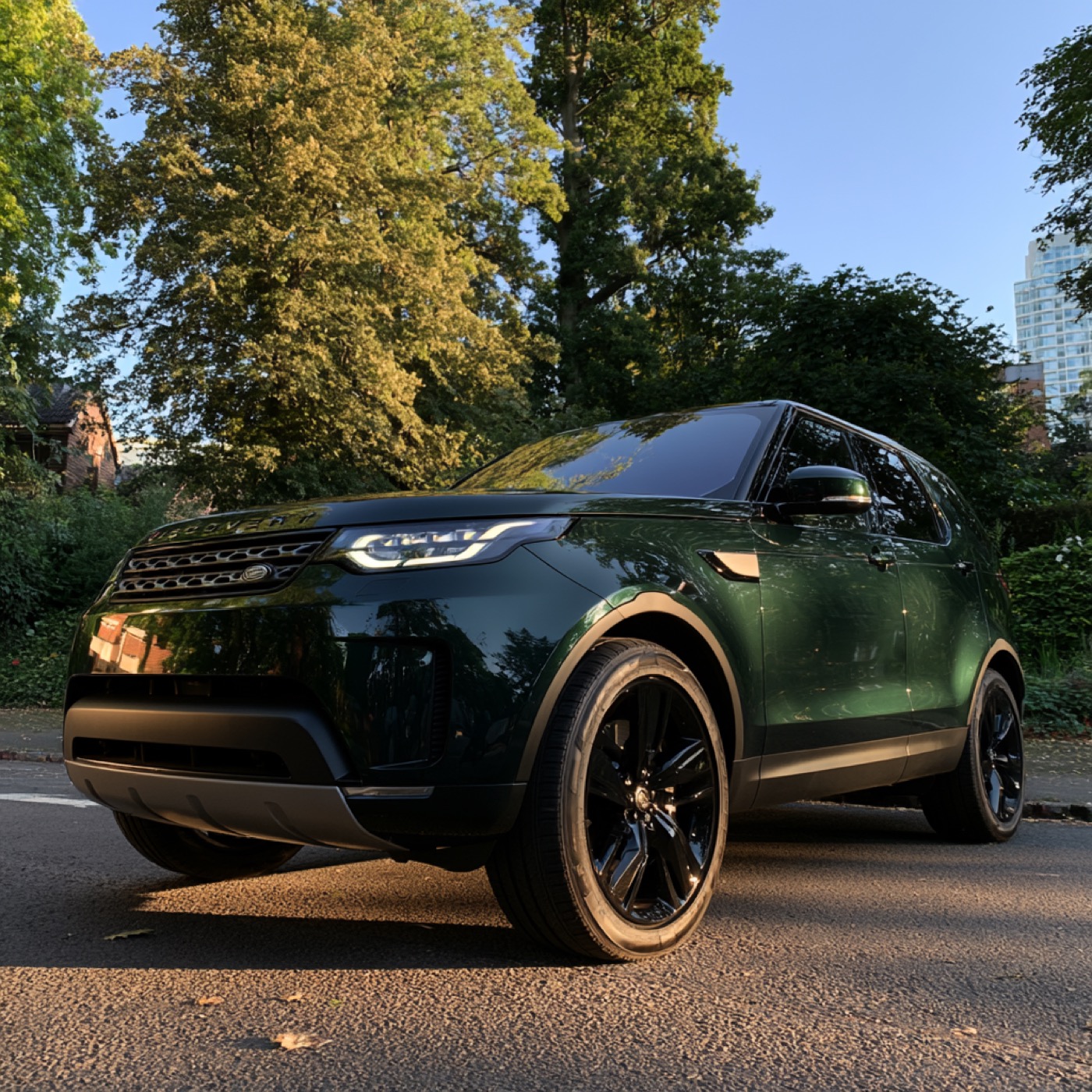
“Four crowns for the car, and the fifth for the green paint. Spec it, get the diesel, find something to tow.”
I was sitting at the lights on New South Head Road, somewhere between Double Bay and the bit where the traffic gives up entirely, doing what you do in Sydney in August, which is squinting at a sky so aggressively blue it feels like a personal insult to everyone I grew up with. And then I looked in my rear-view mirror.
Dark green. Big, upright, slab-sided, three rows, that unmistakable stepped roofline sitting there in my mirror like a piece of my childhood had followed me across the planet and grown up nicely. A Land Rover Discovery, in proper British green, on a Tuesday morning in the Eastern Suburbs, radiating the sort of quiet self-possession that the rest of the traffic could only dream about.
The lights went green. I did not. There was, I'm told, some beeping.
I should explain.
A particular kind of Solihull child
There is a particular kind of Solihull child, and I was one of them. The kind whose dad's alarm went off at half four because the shift started at six. The kind who learned to tell the seasons by whether the queue turning into the works off the Damson Parkway had their headlights on. The kind who could identify a new model from three hundred yards on the strength of one indicator lens, because you'd seen the pre-production mules trundling past the Co-op wearing camouflage wrap like a badly gift-wrapped fridge.
You can move to the other side of the world. I have, quite thoroughly, for eleven years now. You can learn to say "arvo" without irony and develop opinions about which beach has the better car park. But you cannot train yourself out of looking up when a Land Rover goes past. It's not a habit. It's closer to a reflex, like a knee, or a flinch.
So forgive me if I get slightly misty about a paint colour.
Because the Discovery is available in green. Not a hint of green. Not a sort of grey that's had a thought about green and then reconsidered. Green. Deep, dark, wet-holly, Wimbledon-in-the-rain green, the sort of green that looks black under a Midlands sky in February and then catches a stray shaft of Sydney sun on Campbell Parade and detonates into something jewel-like and faintly indecent.
And I want to tell you why that matters, and then I want to tell you about the car underneath it, which is, and I say this as someone constitutionally incapable of objectivity on the subject, an extremely good car that almost nobody talks about properly any more.
First, the colour. Yes, really. Sit down.
We have lost our nerve with paint. This is not a controversial statement. Go and stand in the Westfield car park at Bondi Junction, or any retail park in the Midlands, and count. Grey. Grey. White. Silver, which is grey with better PR. Black. A single act of rebellion in the form of a dark blue that turns out to be grey the moment the sun goes behind a cloud. We have collectively decided, as a species, that the safest thing a car can be is invisible, and we've done it because of residual values, and residual values are the single most joy-destroying force in modern motoring. Nobody ever lay awake as a child dreaming about a strong resale position.
Land Rover, of all companies, should be immune to this. Land Rover is green. The Series I was green because they had a job lot of surplus aircraft cockpit paint left over after the war and it happened to be green, which is the most magnificently British origin story for a design icon in history. No mood board. No focus group. Just a bloke going "well, we've got all this, haven't we." Bronze Green. Pastel Green. Coniston. Epsom. Aintree, which was British Racing Green wearing a flat cap and pretending it wasn't. There is a lineage here as long as the brand itself, and for a good few years it went quiet, and green Land Rovers became the preserve of the classifieds and the county show car park.
So a Discovery in green isn't a paint option. It's an apology being accepted.
And here's the thing about green on this shape specifically. The current Discovery has a fundamentally honest, upright, slab-sided body. Big flat panels down each flank, a proper glasshouse, a roofline that steps up over the third row like the deck of a small ship. Grey does nothing with that. Grey just sits there sulking, making the whole thing look like corporate car park furniture. Dark green reads the shape. It puts shadow into the door creases. It makes the trim, chrome or gloss black depending on how you've specced it, actually mean something. And it does the thing that only the great dark colours do, which is change character with the light. Under Solihull drizzle it's austere and faintly military. Parked above Bronte at seven in the morning with the sun coming in low and sideways off the water, it's a Barbour jacket, a wet dog and a flask of something warm, transplanted somewhere it has absolutely no business looking this good.
There is no rational case for any of this. Rationality is why everything is grey.
Now the awkward bit, because of where I'm from
The Discovery isn't built at Lode Lane any more. It hasn't been since 2018, when production moved to Nitra in Slovakia and a large number of people I grew up around had a very bad few months. I'm not going to pretend that didn't happen, and I'm not going to do the thing where a car writer smooths it over with a paragraph about global manufacturing footprints. Solihull still builds the Range Rover, the Range Rover Sport and the Velar. It is still, in every way that matters to the town, the works. But the Discovery, the family Land Rover, the one that took a generation of us to the caravan site with a boot full of wet swimming things, is assembled a long way east of the A45 now.
What I will say, having crawled around enough of them to know, is that the thing they build there is properly screwed together. The panel gaps are tighter than the D4 ever managed. The doors shut with that dense, damped, expensive-fridge thud. Whatever you feel about where it's assembled, and I feel plenty, the object itself has not been cheapened. That was the fear at the time. It didn't happen.
Right. On with it.
What it actually is, underneath the nice paint
Seven seats. Not five seats and two apologies bolted to the boot floor for insurance purposes. Seven actual seats, with real legroom in row three, reachable by an adult human being who does not hold a yoga qualification. This remains, and I cannot stress this enough, the single most underrated engineering achievement in the mainstream SUV market. Almost every rival that claims seven seats is lying to you by about thirty percent. The Discovery isn't. It was designed around the third row rather than having one negotiated into it late in the process, which is why the roofline steps up, which is why the shape is slightly odd, which is why it works.
Fold them electrically, from the boot, from the touchscreen, or from your phone if you're that sort of person, and you get a load bay measured in rooms rather than litres. Something north of two thousand of them with everything flat. I have moved house in one of these. Not "helped a friend shift some boxes." Moved. House.
The engines are straight sixes, which is the correct number of cylinders arranged in the correct order. The D300 diesel is the one to have and I'll fight anyone who says otherwise: three litres, mild-hybrid assisted, roughly 300 horsepower, and the number that actually matters, around 650Nm of torque, arriving early and staying for the entire afternoon. It doesn't feel fast the way a hot hatch feels fast. It feels inexorable. You press the pedal and the horizon simply starts coming towards you, without drama, without downshifting, without the engine ever raising its voice above the tone of a man clearing his throat politely in a library. There's a P360 petrol six as well, smoother still, thirstier still, and genuinely lovely if you don't do the miles.
It'll tow 3,500kg. That's a proper horse float, a proper caravan, a proper twin-axle trailer with a project car sitting on it, and it'll do it with the trailer reversing system doing the hard thinking for you. You steer with a rotary controller, the car works out the counter-intuitive bit, and twenty years of jackknifed humiliation at the campsite gate simply evaporate. I have watched people who genuinely cannot reverse a trailer place one perfectly on a pitch using this. It is borderline witchcraft.
Air suspension as standard, doing two jobs. On the road it delivers that faintly nautical, long-wave, ocean-liner ride no steel-sprung rival gets near, and you notice it most on the bits of road that whichever council is responsible has clearly decided are somebody else's problem, a category that includes large parts of Warwickshire and, as far as I can tell, most of Old South Head Road. Off the road, the car simply stands up: something like 283mm of clearance at full height, and a wading depth of 900mm. Nine hundred millimetres. That's a full metre of water minus a cigarette paper. You will never need it. That's not the point. The point is that it's there, in the same way that the point of a good coat is not that you're currently standing in a storm.
Terrain Response 2 does the clever bit, and does it invisibly. You can twiddle the modes yourself, mud and ruts, sand, rock crawl, the lot, or you can leave it in Auto and let the car read the surface and quietly reconfigure the throttle map, the differentials, the traction thresholds and the ride height without telling you. That's what nearly everyone does, and it is, I think, the whole modern Land Rover thesis in one sentence: enormous capability, arranged so that you never have to think about it. All-Terrain Progress Control is off-road cruise control. Set a walking pace, take your feet off both pedals, steer, and the car picks its way down something horrible while you concentrate on not hitting a tree. ClearSight Ground View stitches camera feeds together to show you the ground underneath the bonnet, which sounds like a gimmick right up until the first time you place a front wheel precisely on a rock you cannot physically see, and then it is the best feature on any car ever made.
Inside, where you'll actually be
An 11.4-inch curved glass screen running Pivi Pro, which, and this is faint praise in an industry that has largely forgotten how to write software, is one of very few systems in any car that responds when you touch it rather than after a period of quiet reflection. Wireless CarPlay and Android Auto as standard. A row of physical climate controls that survived the great purge, hallelujah. Meridian audio that's genuinely good rather than good-for-a-car.
Materials have crept quietly upmarket over the past few model years without anyone shouting about it. Wool-blend and technical velour options if you'd rather not have leather, brushed metal that is actually metal, and a general sense that the surfaces you touch most often were specified by someone who touches surfaces. There's a fridge in the centre console on the higher trims, which is exactly the sort of gloriously unnecessary feature that makes a car endearing, and which, in a Sydney February, stops being a novelty and starts being the reason you bought it.
And the storage. Oh, the storage. Land Rover have always been mildly obsessive about cubbyholes and the Discovery is the purest expression of it. A hidden bin behind the climate panel big enough for four phones and a wallet. Door pockets you could post a terrier through. A cavity under the armrest with its own postcode. It is a car designed by people who have children, and it shows in a way no amount of marketing about family adventure ever manages to convey.
The recent additions to the range have been sensible rather than showy: a driver attention monitor that watches for you drifting off, a mid-tier Landmark edition slotting in between the entry car and the flagship Tempest, some new colourways top and bottom. Nobody has reinvented anything. Good. The Discovery never needed reinventing. It needed leaving alone and quietly improving, which is broadly what has happened.
So is it any good?
Here is the honest problem with the Discovery, and it isn't a dynamic one. The problem is that it sits in a showroom next to a Range Rover Sport, and the Range Rover Sport is prettier, and a great many people who need a Discovery buy a Range Rover Sport instead and then spend the next five years quietly regretting the boot. The Discovery is the sensible sibling. It's the one that turns up on time, carries everything, tows the thing, does the school run and the site visit and the drive to Byron with four people and a fortnight's luggage, and never once asks to be admired.
Which is exactly why the green matters.
Because a grey Discovery is a tool, and a tool is something you resent slightly. A green Discovery is a character. It has an opinion. It looks like it belongs to somebody who does something interesting, who has dogs, or a boat, or a nineteen-year-old MGB in a garage that has been nearly finished since 2019. It takes the most quietly competent, least celebrated, most genuinely useful large car on sale, and it hands back its personality.
Nearly eighty years ago a factory in my town painted a car green because that's what was in the store cupboard, and accidentally created the most recognisable silhouette in British motoring. The fact that you can walk into a dealership today, in Solihull or in Sydney, and order a Discovery in a deep, proper, unapologetic green is not nostalgia. It's the company remembering out loud what it is.
So spec it in green. Spend the money on the paint and skip whatever wheel upgrade they're pushing this month. Get the diesel. Get the tow pack even if you have nothing to tow, because you will find something. Then drive it out through the Royal National Park on a wet Tuesday, or towards Henley-in-Arden on a wet everything, and watch the colour shift from black to bottle glass as the light moves, and tell me you'd rather have the grey one.
You wouldn't. Nobody ever has. They just tick it because of what the computer says it'll be worth in three years, and that, ladies and gentlemen, is how a nation loses its nerve.
Whoever you were, in the green Disco on New South Head Road: sorry about the lights. You'll understand when I tell you my dad did thirty-one years at Lode Lane.
Written by someone who lives twelve thousand miles from Solihull and still, without fail, looks up when a Land Rover goes past.
Your car texts you now.
Pet names, painted portraits, rego reminders as messages from the car herself - and never a scrap of your data. The Royal Garage, our iOS app.
Meet the app